Wednesday, January 30, 2013

Earthship Simple Survival Concept

Weston Bernhardt explained to me an environmental concept called "Earthships" that promoted the idea of a sustainable future.  I researched the topic and found an interesting website by a company called Earthship Biotecture explaining the construction of Earthships in Haiti.  The website's introduction stated:
  • Fuel prices keep going up
  • The housing market is big and inefficient
  • Natural resources are dwindling
And finally that the Earthship Simple Survival Concept was our answer to these issues.


Click here for an explanation of Earthships...

Earthships would be a very sustainable way to live.  It would make a huge difference if a large portion of people decided to live this way.

Diagrams of the Earthships constructed in Haiti:
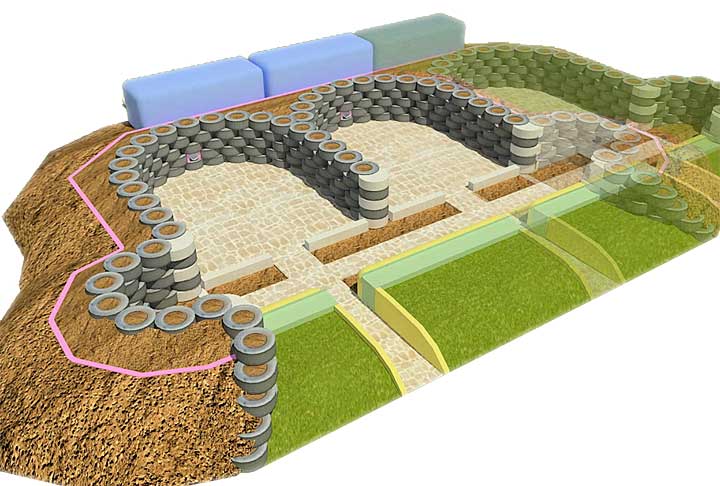


Earthship Biotecture explains the simple necessities all humans need:

  1. Shelter, and a comfortable living space
  2. Water
  3. Sanitation (Sewage Treatment)
  4. Energy
  5. Food
  6. Garbage recycling concepts

"We need to be able to obtain the above in a way that is not subject to thirty year mortgages and hundreds of thousands of dollars. 
We need to be able to obtain the above in a way that does not cause devastation to the planet  we all live on."

The Simple Survival Earthship meets all of these human requirements without the problems that modern housing has. I think this concept answers a lot of questions that the research I've done so far has brought up.


Links:


Wednesday, January 9, 2013

National Environmental Policy Act of 1969

Established when signed into law by president Nixon, the NEPA requires all major federal actions that  affect the environment to be accompanied by an environmental impact statement, identifying any environmental hazards or effects the action will create.  NEPA is a procedural statute with two main goals:
1) It obligates federal agencies to consider all environmental repercussions before proceeding.
2) It ensures that these agencies will inform the public as to what the action is and the effects it will have on the environment.

There are three different classes of action that determine the documentation NEPA requires to properly review a federal action:

Class I: Environmental Impact Statement (EIS)- Reserved for actions with a significant effect on the environment.

Class II: Categorical Exclusion- Required when actions do not have a signifiant effect, cumulatively or individually, on the environment.

Class III: Environmental Assessment- For actions that have an unclear or loosely established effect on the environment.

Every NEPA planning process takes steps to look at the following aspects:

-Purpose and need: Establishes what the project's for and why it's necessary.

-Affected Environments and Constraints: Describes the project area, location, and specifications.

-Alternatives: All alternatives are considered.

-Public Involvement: Involving the public in some way.

-Mitigation: Developing mitigation strategies (if applicable).


Links:

http://www.fta.dot.gov/documents/Unit1_01CRSReport.pdf

http://www.coloradodot.info/programs/environmental/planning-env-link-program/background/what-is-nepa.html


History of Environmental Policy in the US

On January 1st of 1970, President Richard Nixon signed the National Environment Policy Act (NEPA), which established the President's Council on Environmental Quality. The NEPA is one of the earliest policies regarding environmental protection and is often referred to as the "environmental Magna Carta." In this same year, President Nixon signed the Clean Air Act making the US a global leader in environmental preservation. On December 2 of 1970, Nixon signed a bill creating the US Environmental Protection Agency (EPA), an organization that protects human health and the environment through regulations and laws passed through Congress.  Then, in 1973 the UN held the first meeting of the Council of Environmental Ministers, at which the very first Environmental Action Programme was adopted by national government representatives.  These policies established in the early 70s were the first signs of an awareness of environmental issues.


Links:

http://en.wikipedia.org/wiki/Environmental_policy

http://en.wikipedia.org/wiki/National_Environmental_Policy_Act

http://en.wikipedia.org/wiki/United_States_Environmental_Protection_Agency

http://fr.wikipedia.org/wiki/Fichier:Richard_M._Nixon,_ca._1935_-_1982_-_NARA_-_530679.jpg

Wednesday, December 12, 2012

Solar Energy and PV Systems

Another article on the Energy Department's website described a project known as the SunShot Initiative; the intention being to make solar energy competitive with other leading forms of energy without subsidy by 2020.  Under the Initiative, the Energy Department recently invested $29,000,000 into four different projects that will reduce the cost of solar energy benefitting both U.S. businesses and families.  Secretary Chu commented "The price of solar panels has fallen dramatically in recent years, but we also need to reduce the cost and time required to actually install them in homes and businesses... Projects like these can help reduce the cost of solar power and make it easier for American families and businesses to access clean, affordable energy."  I think this quote is fantastic because it shows that someone is actively trying to make a public shift from the wasteful, dirty energy we consume en masse today.  The article also discussed plug-and-play photovoltaic (PV) systems, which make buying and installing solar panels much easier.  I personally hope that these PV systems are the first steps in making personal solar panels a commonality across the United States.


Links:

http://apps1.eere.energy.gov/news/daily.cfm/hp_news_id=371

http://www.pv-magazine.com/news/details/beitrag/us-to-invest-up-to-25-million-in-plug-and-play-pv-systems_100006541/#axzz2ErqoHTtj

http://www.granitetransformations.com/blog/1871/the-benefits-of-using-solar-panels-at-home/

http://eddiewilliams2.wordpress.com/

U.S. Department of Energy: Fuel Efficiency

I discovered an intriguing article on the USDE's website about government programs that prioritize fuel efficient vehicles and improve America's transportation system, making it more sustainable.  The Energy Department recently announced 20 new projects to improve accessibility to the training and tools needed to produce more fuel efficient vehicles.  U.S. Energy Secretary Steven Chu comments that these programs will "...give American families, businesses, and communities more options and reduce fueling costs. At the same time, these projects will help lead the way to further reducing America's dependence on foreign oil and protecting our nation's air and water."  These programs improve the country's sustainability through the Energy Department's Clean Cities Initiative, a group of coalitions that aim to make certain major US cities and certain private companies more energy efficient and clean. The city of Austin, Texas was recently awarded half a million dollars to assist companies that make a lot of deliveries to make their fleet of trucks more energy efficient, while offering training seminars on electric vehicles.  Additionally, Kansas City, Missouri will be given roughly $815,000 that will establish a Green Fleet Technical Assistance and Certification program to encourage companies to asess their fuel consumption and emission levels.

Wednesday, December 5, 2012

Civic Center in Frisco

The article I read on San Francisco led me to search for examples of their sustainability.  One of the first articles that caught my attention was about an eco-friendly Civic Center that mayor Gavin Newsom announced in September of 2008.  The idea was to restructure the existing center into a "sustainable resource district."  The project uses solar panels, wind turbines, and living roofs to reduce the city's carbon footprint by 2,225 tons.  The panels and turbines reduce the district's energy consumption by almost a third, while water efficient fixtures and water reclamation programs conserve 80% of water used.  When construction plans were released, Mayor Newsom stated, "...our Civic Center will stand as a global model for how we achieve a more sustainable future."

Here's a concept photo of the Civic Center:


And here's a photo of the completed Civic Center:


Links:

http://inhabitat.com/san-francisco-sustainable-civic-center/

http://sfcitizen.com/blog/2011/09/30/omg-this-morning-in-civic-center-its-civic-response-2011-a-fire-drill-with-a-cast-of-thousands/

Sustainability and San Francisco

I discovered an article on the Siemens corporation's website regarding San Francisco and the fact that it's the most environmentally sustainable city in the United States.  It was closely followed by New York, Seattle, Denver and Boston as the top five.  These cities were compared out of 27 total by the Economist Intelligence Unit. The study, known as the Green City Index was commissioned by Siemens.  To determine the most sustainable city, they looked at 9 environmental categories: CO2 emissions, energy, land use, buildings, transport, water, waste, air quality, and environmental governance.  Eric Spiegel, the president of the Siemens corporation identified these cities as "the driving force behind the nation's sustainability efforts."  He goes on to say, "Despite the fact that we don't have a federal climate policy... 21 of the 27 cities have already set their own carbon reduction targets.  Cities are creating comprehensive sustainability plans, utilizing current technology, and proving everyday that we don't have to wait to create a more sustainable future."  I was excited to read this quote because I completely agree that NOW is the time to create sustainable cities, and I'm glad that such a powerful, influential man shares my viewpoint.  The cities that performed the best on the survey were found to have plans that covered every category of sustainability (CO2 emissions, water, land use, etc.)  The Green City Index seems to be a very precise means of determining the most sustainable areas in our country, so we can follow their example across all of the United States.

Link: http://www.siemens.com/press/en/pressrelease/?press=/en/pressrelease/2011/corporate_communication/axx20110673.htm